smd-server(1)
NAME
smd-server - sends diffs and mails to smd-client
SYNOPSIS
   smd-server [--exclude glob] [-v|--verbose] [-d|--dry-run]
         [--get-mddiff-cmdline] [--stop-after-diff]
         [--override-db dbf] [--dump-stdin tgt] endpoint mailboxes
DESCRIPTION
   smd-server  needs  to  know a name (endpoint) for the client (that must
   not be used by others) and a list of mailboxes (directories).

   smd-server first calls mddiff(1), then prints on stdout  the  generated
   diff.  It  then accepts from stdin a small set of commands a client may
   issue to request a file (or parts of it, like the header).

   smd-server is in charge of committing the db file used by mddiff(1)  in
   case the client communicates a successful sync.
OPTIONS
   -v --verbose
          Increase program verbosity (printed on stderr)

   -d --dry-run
          Do not perform any action for real

   -n --no-delete
          Do not track deleted files

   --exclude glob
          Exclude paths matching glob

   --override-db dbf
          Use dbf as the db-file

   --get-mddiff-cmdline
          Print the command line used for mddiff and then exist

   --stop-after-diff
          Send  the  actions  to  the  other endpoint and exit. If used in
          conjunction with  --override-db,  dbf  is  removed  just  before
          exiting

   --dump-stdin tgt
          Dump standard input to tgt and exit
NOTES
   smd-server  is  a  low level utility. You should use higher level tools
   like smd-pull(1) and smd-push(1)
SEE ALSO
mddiff(1), smd-client(1), smd-pull(1), smd-push(1)
AUTHOR
   Enrico Tassi <[email protected]>

                           18 November 2015                  smd-server(1)
Opportunity
Personal Opportunity - Free software gives you access to billions of dollars of software at no cost. Use this software for your business, personal use or to develop a profitable skill. Access to source code provides access to a level of capabilities/information that companies protect though copyrights. Open source is a core component of the Internet and it is available to you. Leverage the billions of dollars in resources and capabilities to build a career, establish a business or change the world. The potential is endless for those who understand the opportunity.
Business Opportunity - Goldman Sachs, IBM and countless large corporations are leveraging open source to reduce costs, develop products and increase their bottom lines. Learn what these companies know about open source and how open source can give you the advantage.
Free Software
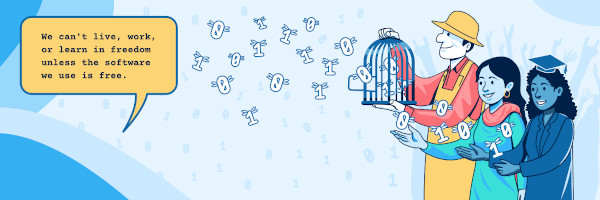
Free Software provides computer programs and capabilities at no cost but more importantly, it provides the freedom to run, edit, contribute to, and share the software. The importance of free software is a matter of access, not price. Software at no cost is a benefit but ownership rights to the software and source code is far more significant.
Free Office Software - The Libre Office suite provides top desktop productivity tools for free. This includes, a word processor, spreadsheet, presentation engine, drawing and flowcharting, database and math applications. Libre Office is available for Linux or Windows.
Free Books
The Free Books Library is a collection of thousands of the most popular public domain books in an online readable format. The collection includes great classical literature and more recent works where the U.S. copyright has expired. These books are yours to read and use without restrictions.
Source Code - Want to change a program or know how it works? Open Source provides the source code for its programs so that anyone can use, modify or learn how to write those programs themselves. Visit the GNU source code repositories to download the source.
Education
Study at Harvard, Stanford or MIT - Open edX provides free online courses from Harvard, MIT, Columbia, UC Berkeley and other top Universities. Hundreds of courses for almost all major subjects and course levels. Open edx also offers some paid courses and selected certifications.
Linux Manual Pages - A man or manual page is a form of software documentation found on Linux/Unix operating systems. Topics covered include computer programs (including library and system calls), formal standards and conventions, and even abstract concepts.